






















Partnerships
How StoreSync Helps Kino’s Coffee Manage Three Locations
Aug 31, 2026
TLDR
A third coffee shop brings far greater operational demands than simply adding another address. Stock moves differently, staff needs clear instructions, recipes must stay accurate, and managers need to know what is happening without visiting every store. Kino’s Coffee experiences this every day across its locations in Cissna Park, Paxton, and Rantoul, Illinois. StoreSync gives the business one place to manage the work behind the counter, including inventory, recipes, costs, schedules, checklists, and live orders.
How StoreSync Keeps Three Kino’s Coffee Locations in Sync
Kino’s Coffee began in Cissna Park in 2019 with a simple goal: serve great coffee and treats in a place where the local community feels welcome. The business has since expanded into Paxton and Rantoul, bringing the same experience to three Illinois towns.
For Jared Kaeb and his team, growth changes what happens behind the counter. Each shop has its own stock levels, employees, schedules, and daily needs. Still, a customer visiting Rantoul should receive the same quality and service as someone ordering in Cissna Park or Paxton.
That consistency depends on details that customers may never see. Every barista needs the current recipe. Managers need accurate costs when reviewing menu prices. Each shop must know what it has available and what needs to be ordered. Opening, closing, and preparation tasks must be completed at the right time.
StoreSync keeps that information connected across the business. Staff can count supplies on their phones, managers can see activity for their shop, and Jared can follow all three without collecting separate updates from each one.
The system now supports a business with over 140 core menu items and 367 recipe variations. That scale makes accurate information essential, especially when a single drink can include several customer-selected modifiers.
StoreSync Was Built Behind the Counter at Kino’s
The idea comes directly from the technology Kino’s already uses.
Square sits at the center of the operation. Per Diem supports the customer experience through Kino’s mobile app, online ordering, loyalty, and push notifications.
Seeing how well a focused product could handle that side of the business led Jared to think about the work taking place inside the shops.
“We loved what Per Diem did for the customer-facing side of our business. It made me realize there should be that same kind of purpose-built experience for everything happening behind the counter. That idea eventually became StoreSync.” Jared Kaeb, founder of StoreSync and Kino’s Coffee
The product was developed inside Kino’s and is still used there every day. New ideas could be tried during real shifts, with feedback coming from the same managers and employees expected to use them.
That matters in a coffee shop, where small details can affect the whole day. Milk may be purchased by the case but counted by the carton. A supplier price change can alter the cost of every drink using that ingredient. A new recipe needs to account for each modifier available through Square.
Building the system in that setting keeps its development close to the work it is designed to support.
From Stock Counts to Shift Schedules, Everything Has a Place
The different parts of coffee shop operations affect one another. Recipes determine ingredient use. Vendor prices change the cost of a drink. Sales affect stock levels. Staffing decisions influence labor spending.
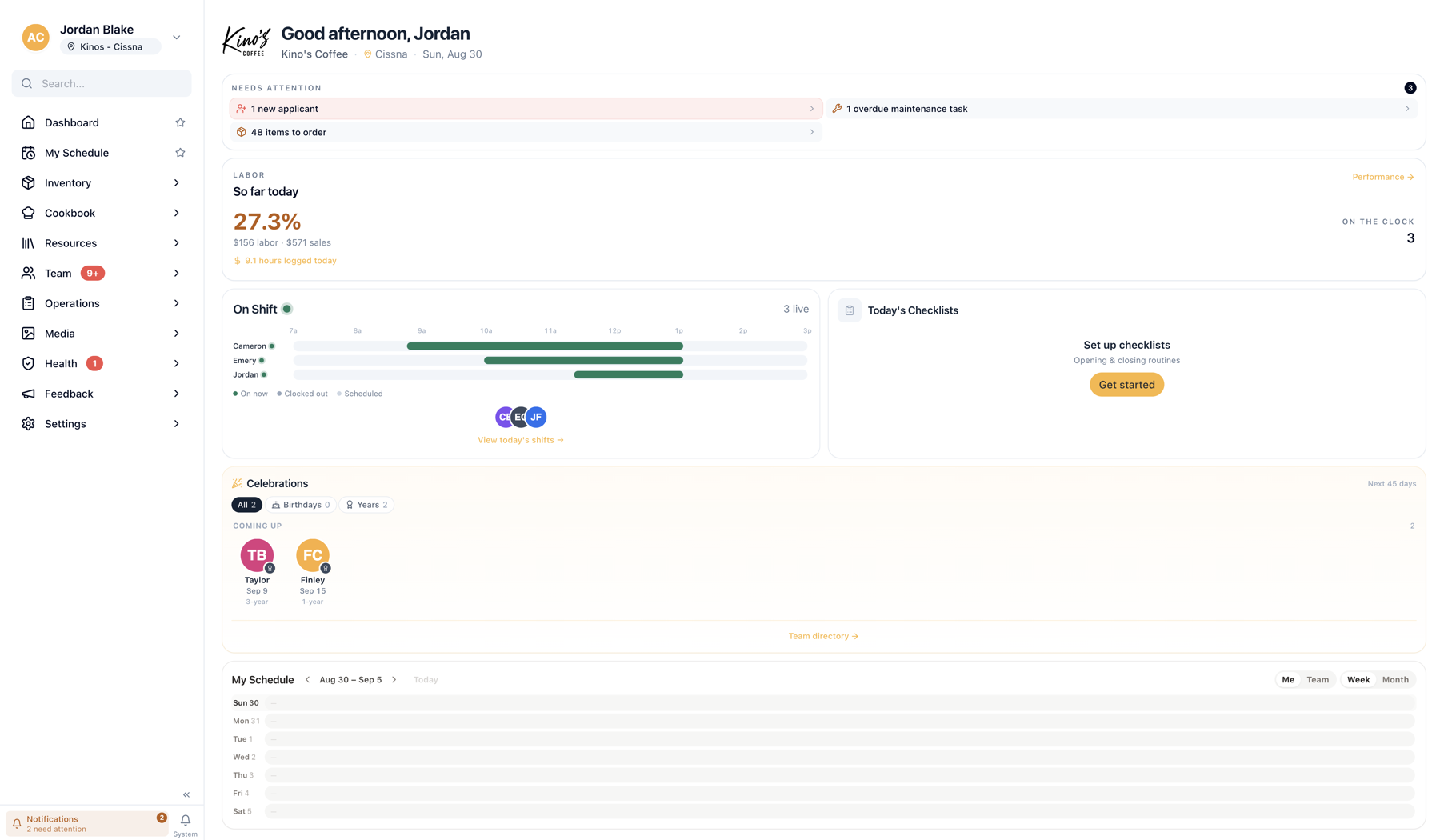
Inventory and purchasing start with one item list across every shop. Employees can complete counts on their phones during a shift. When an item drops below its required minimum, it can be added to a purchase order.
Recipe costing uses real pack sizes and current vendor prices. It also accounts for the modifiers customers can select through Square. If the price of a case changes, the cost of every drink using that ingredient updates with it.
Scheduling works with Square Scheduling and Team, and managers can build the week in StoreSync and publish it back to Square. Employees who are not registered in Square can also be added to the schedule. Labor reporting uses the same Square time punches connected to payroll.
Checklists cover opening, closing, and preparation work on a phone. Each completed task can include the employee’s name, a timestamp, and a photo when proof is needed.
These tools give managers a practical view of the work happening inside each shop without separating inventory, labor, recipes, and recurring tasks into unrelated systems.
How Square, Per Diem, and StoreSync Fit Together
Each product has a defined role in the Kino’s setup.
Square handles payments and records the central business activity. Per Diem gives customers a branded way to order ahead, earn loyalty rewards, and receive updates through the Kino’s app. StoreSync supports order preparation and the wider operation behind the counter.
The kitchen display shows how the three work together.
A customer places an order through the Kino’s app. Per Diem sends that order to Square, where it becomes available on the StoreSync kitchen display. The barista sees the live ticket on the make line and prepares the order.
When the ticket is completed on the kitchen display, the fulfillment update is written back to Square. That update fires the customer’s ready notification.
Per Diem and StoreSync work from the same Square account. Per Diem handles the experience before and after the order, while StoreSync helps the shop manage what happens once the order reaches the counter.
Final Thoughts
StoreSync began as an internal system for running Kino’s across three towns. It is now available to other coffee shops using Square, with a free 14-day pilot that does not require a card.
Its value comes from where it was built. The product is shaped by people who manage shops, schedule employees, count ingredients, review costs, and serve customers every day.
Jared and his team will also introduce it to a wider group of operators at Coffee Fest Dallas Fort Worth in October 2026.
For growing coffee businesses, Kino’s offers a useful example of how focused technology can work around one central system. Square powers the sale, Per Diem supports the customer relationship, and StoreSync manages the operational work that follows.