




















Coffee
Mobile App Development for Coffee Shops: The Complete Guide
Aug 28, 2026
TLDR
Most coffee shop owners come to app development from the same place: the line is long, the phone keeps ringing with call-in orders, and a third party is taking a cut of the orders that were already yours.
The question is not really "should I get an app." It is "what do I actually need, and what will it cost me to run."
This guide walks through the honest version of that answer: what marketplaces really cost you, the four ways a coffee shop can end up with an app, what "native" means and when it matters, and why the website, the online ordering, and the app are one decision rather than three.
Your ordering experience is the product now
A regular does not think about your point of sale. They think about whether their oat milk cortado takes forty seconds or four minutes to order.
That is the whole competitive picture for a coffee shop in 2026. The big chains did not win the morning because their coffee is better. They won it because ordering ahead became a habit, and habits are hard to break. A customer who has your usual saved, their card saved, and their rewards balance visible is not comparing you to the cafe two blocks over. They already ordered.
Which means the ordering experience is not a side channel to your business. For your best customers, it is your business, and it deserves the same attention as your espresso program.
What third-party marketplaces actually cost you
Commission is the obvious cost, and it is a real one. Delivery marketplaces typically charge somewhere in the range of 15% to 30% per order, depending on the plan and the level of promotion you sign up for.
On a $6 latte, a 25% commission means the marketplace takes $1.50 before you have paid for beans, milk, cup, lid, labor, or rent. Coffee is a thin-margin business at the best of times. That is not a rounding error.
But commission is not the expensive part. The expensive part is that you do not get the customer.
When someone orders through a marketplace, the marketplace owns the relationship. They have the email address. They decide what shows up next to your listing. They can promote the cafe down the street to the person who just bought from you. You cannot email your own regulars, because they were never really your regulars — they were the platform's users, who happened to buy your coffee.
The test is simple. If you wanted to tell everyone who bought a matcha latte last month about your new matcha menu, could you? If the answer is no, you are renting your customer list.
The four paths to a coffee shop app
There are really only four ways a coffee shop ends up with an app. All four are legitimate. They suit very different businesses.
1. Get listed in a marketplace app
What it is: you appear inside someone else's app alongside every other place in town.
Good: no build, no upfront cost, immediate exposure to people who have never heard of you.
Not good: commission on every order, no branding, no customer data, and you are one search result among hundreds. Useful for discovery. A bad place to put your regulars, who already know exactly where you are.
2. A DIY app builder
What it is: a general-purpose drag-and-drop tool that outputs an app.
Good: cheap, fast, entirely under your control.
Not good: general-purpose tools do not know what a coffee shop is. Modifier-heavy drink builds, half-caf and oat-milk substitutions, cup sizes with different prices, loyalty that has to match what happens at the counter — these are exactly the things a generic builder handles badly or not at all. And the app almost never syncs cleanly with your point of sale, which means someone re-keys orders during the rush.
3. A fully custom build
What it is: you hire a development agency or a freelance team to build an app from scratch.
Good: you get precisely what you specify. If your concept genuinely needs something nobody else offers, this is the only path that delivers it.
Not good: cost and time, and neither ends at launch. Custom software is not a purchase, it is a dependency. iOS and Android ship breaking changes every year, your POS changes its API, someone has to fix the checkout bug on a Saturday morning. Unless you plan to keep a developer on retainer indefinitely, a custom app slowly becomes an app nobody can safely change.
For a large multi-unit brand with a dedicated technology budget, this can absolutely be the right answer. For most independent cafes, it is a large bill for something a platform already does.
4. A white-label platform built for your POS
What it is: a platform that publishes a real app under your brand, connected to the point of sale you already run.
Good: you get the app, the ordering, and the integration as one product, and the maintenance is somebody else's job. Because the platform is built for food and drink, the awkward parts — modifiers, scheduled pickup, loyalty, multiple locations — are already solved.
Not good: you work inside the platform's feature set. If your concept needs something genuinely unusual, you will hit an edge you cannot cross.
This is the path Per Diem is on, and it is the right path for the large majority of coffee shops, cafes, bakeries, and boba shops — not because the others are bad, but because the day-to-day problem is not unusual. It is a morning rush, a menu with a lot of modifiers, and a group of regulars worth keeping.
Native app, or a website in a wrapper?
This is the question most owners do not know to ask, and it is the one that shows up every morning.
A lot of "apps" are a website in an app-shaped shell. You download it from the App Store, but what opens is a web page. It usually looks fine in a demo. Then a real customer uses it on a cold sidewalk with one bar of signal, and the difference becomes obvious.
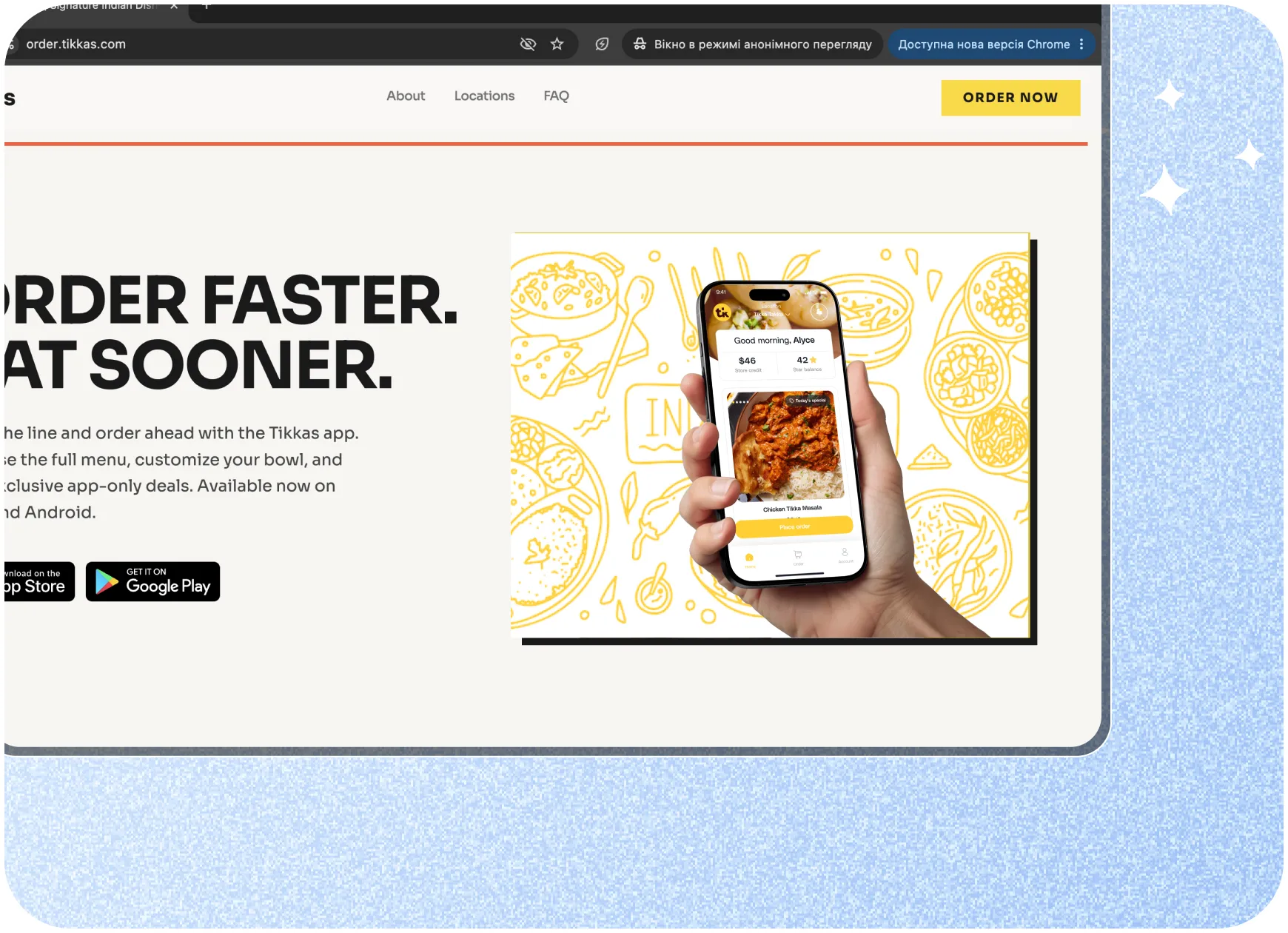
Per Diem builds your app natively for iOS and Android. It is a real app compiled for the phone, published under your business name and your artwork.
What that buys a coffee shop, specifically:
- Apple Pay and Google Pay that actually work like Apple Pay. Double-click, face, done. Not a payment form pretending to be a wallet.
- Push notifications you own. "Your order is ready" the moment it hits the counter, and "Matcha Monday, 15% off" on the afternoon you need traffic. A wrapped web app either cannot do this reliably or has to beg for permission through the browser.
- Speed on a bad connection. The app opens with the interface already on the phone. Only your menu and order data travel over the network.
- A place on the home screen. Your icon sits next to their bank and their messages. That is real estate you do not rent.
- A listing in the App Store and Google Play. Under your name, with your screenshots, findable by people searching for you.
Native is not a technical preference. It is the difference between an app your regulars keep and one they delete after a bad morning.
The part most guides skip: it is not just an app
Here is where the usual "how to build a coffee shop app" advice quietly falls apart.
You do not have an app problem. You have an ordering problem, and it shows up in three places at once:
- Someone finds you on Google. They need a website that loads fast, shows the menu, and lets them order right there.
- Someone wants to order but will not install anything. A first-timer, a tourist, an office admin ordering for eight people. They need web ordering in the browser.
- Someone comes in four times a week. They need the app, the saved usual, the rewards, the one-tap reorder.
Solve those separately and you are running three vendors, three menus, and three sets of customer data — and the customer who orders on the web on Tuesday and in the app on Thursday looks like two different people to you. Their loyalty points do not follow them. Your "new seasonal drink" email misses half of them.
Per Diem is one platform for all three: a branded website, web ordering for people who will not download an app, and a native iOS and Android app for the regulars — sharing one menu, one customer record, and one loyalty balance, all connected to Square.
Update a price in Square and it changes everywhere. Someone earns points on the web and redeems them in the app. You see one customer, because there is one customer.
If you want the short version of that argument, it lives on our coffee shop app, website and web ordering page.
Marketing that knows where the customer is
Owning the customer relationship is only worth something if you can act on it. This is the part of the platform that turns a customer list into repeat orders.
Campaigns target by location. If you run more than one shop, a promotion does not have to go to everybody. Send the slow-Tuesday offer to the one store that is slow on Tuesdays. Announce a new seasonal drink at the location that actually has it. Push the grand-opening offer to the customers in that neighborhood rather than across town. One brand, one app, but the message is specific to the shop the customer actually walks into.
The journey adapts to what the customer does. Rather than one blast to one list, the sequence responds to behavior: a welcome offer after the first order, a nudge to the customer who has not been in for three weeks, a reward when a streak is building, something on their birthday. Someone who orders every morning and someone who tried you once in July should not get the same message, and they do not have to.
Every channel comes from one place. Push notifications, SMS, and email all run off the same customer record and the same segments — no separate email tool, no separate SMS vendor, no exporting a CSV between systems. Push notifications are unlimited, and every plan includes a monthly allowance of SMS and email on top, so the day-to-day messaging that keeps regulars coming back is not metered against you. See marketing and CRM for what is included at each tier.
This is the difference between having a customer list and having a marketing program. The list is only the raw material.
What a coffee shop app actually needs
Ignore feature lists that could describe any business. These are the ones that matter behind a coffee counter:
- Order-ahead pickup with a real time estimate. The entire point is skipping the line.
- Modifiers that survive the trip from your POS. Milk, shots, syrups, temperature, size. If a customer cannot order their actual drink, they will not order twice.
- One-tap reorder. Your regulars buy the same thing most mornings. Make it one tap.
- Loyalty that matches the counter. Points earned online and in store on the same balance. Per Diem supports Square Loyalty directly, so the app does not run a second, competing rewards scheme.
- The wallets people already use. Apple Pay, Google Pay, cards, store credit, gift cards.
- Push, SMS, and email you control. Your customer list, your message, no marketplace in between — and all three channels from one system rather than three subscriptions.
- Targeting by location and by behavior. The right store, the right customer, the right moment. A promotion for one location, a win-back for the regular who has gone quiet.
- Scheduled and group ordering. The 9am office run is one of the largest tickets a cafe sees all day.
- Multi-location support. Even if you have one store today. Migrating later is not free.
- POS sync that runs both ways. Menu and price changes flow out; orders flow back into the workflow your baristas already know.
For the design side of this, our guide on mobile app design best practices goes deeper.
How a launch actually runs
- Connect Square. Your catalog, modifiers, prices, and locations come across. You are not retyping your menu.
- Brand it. Colors, logo, artwork, icon. It should look like your shop, because it is your shop.
- Set up ordering. Pickup times, prep buffers, delivery if you offer it, catering and group ordering if you want them.
- Turn on loyalty and promos. Rewards, referrals, birthday offers, whatever fits how you already treat regulars.
- Publish and tell people. We handle the App Store and Google Play submission. You handle the counter — a sign, a QR code, and baristas who mention it. The last step is the one that decides whether the first four mattered.
Store review timelines are set by Apple and Google, not by us, so treat launch day as a range rather than a date.
What it costs
Per Diem's pricing is public, per location, per month:
- Starter — $99/month. iOS and Android, web and QR ordering, delivery, catering and group ordering, gift cards and promos, Square Loyalty support, push notifications.
- Pro Plus — $199/month. Everything in Starter, with lower per-order usage fees and more marketing tooling.
- Premium — $499/month. No usage fees at all, which is where high-volume shops usually land.
Usage fees on the lower tiers are small and per-order, and are passed to the customer by default rather than absorbed by you.
Compare that to the commission model honestly. A shop doing 500 online orders a month at an average ticket of $12 hands roughly $1,500 a month to a marketplace at 25%. The comparison is not "free versus $99." It is a percentage of everything, forever, versus a fixed line item you control.
A custom build is a different budget conversation entirely, and it does not end when the app ships — someone has to maintain it every year after.
How to tell it is working
Downloads are a vanity metric. Watch these instead:
- Repeat order rate. What share of app customers order again within thirty days? This is the number that says whether you built a habit or a novelty.
- Share of orders coming direct. Direct versus marketplace, tracked monthly. This should climb.
- Loyalty enrollment among app users. If it is low, sign-up is buried in the flow.
- Average ticket, app versus counter. Ordering ahead usually means people add the pastry.
- Line pressure during peak. Ask your baristas. If the 8am rush feels calmer, the app is doing its job even before the dashboard says so.
We go deeper on this in six essential mobile app growth metrics.
FAQ
How much does it cost to build an app for a coffee shop?
With Per Diem, from $99 per month per location, with no upfront build cost. A custom-built app from an agency is a much larger investment and carries ongoing maintenance costs after launch, which is why most independent cafes choose a platform.
How long does it take to launch?
Setup is quick once your Square catalog is connected and your brand assets are ready. The variable is App Store and Google Play review, which is on Apple's and Google's timelines rather than ours. Our team walks you through each step and gives you a realistic date for your shop.
Do I have to replace my POS?
No. Square stays your point of sale. Per Diem adds the website, ordering, app, loyalty, and marketing on top of the setup your staff already knows.
Is a native app really better than a mobile website?
They do different jobs, which is why you want both. The website and web ordering catch everyone who will not install an app. The native app is for regulars, and it is meaningfully better for them: Apple Pay, push notifications, home screen presence, and speed on a weak signal.
Do online orders show up in Square?
Yes. Orders from your website and your app land in Square, so your team works from one ticket flow instead of watching a second screen.
Will my customers actually download it?
Some will, if you give them a reason and make it easy. The shops that succeed put a QR code at the register, brief their baristas to mention it, and offer something on the first order. An app nobody is told about does not get downloaded.
Can I send different promotions to different locations?
Yes. Campaigns can target a specific store and the customers around it, so a slow afternoon at one shop or a new drink at another does not have to be announced to your entire list. Messages can also follow behavior rather than a calendar — a welcome after the first order, a win-back for someone who has gone quiet, a birthday offer.
Does this work for a single-location coffee shop?
Yes, and single shops often see the effect fastest, because a small regular base makes a large share of the revenue. Multi-location support is there when you grow into it.
What happens to my loyalty program?
It comes with you. Per Diem supports Square Loyalty, so customers earn and redeem on the same balance whether they order in store, on the web, or in the app.
Where to start
If you take one thing from this guide, make it this: your website, your online ordering, and your app are one decision, not three. Split them across vendors and you split your customers along with them.
See what Per Diem looks like for a coffee shop, or book a demo and we will walk through your menu, your Square setup, and what launch would actually look like for your shop.