






















Delivery Apps
Why Restaurant Delivery Orders Get Cancelled and How to Prevent It
Sep 3, 2026
TLDR
A customer places a delivery order, the restaurant starts preparing it, and then the delivery gets cancelled because no driver takes the job. In other cases, a driver accepts but later drops it, the delivery falls outside practical limits, or the restaurant cancels the courier request itself. Each situation looks like the same cancelled order to the customer, but the cause can be completely different. With 37% of U.S. adults ordering restaurant delivery at least once a week, according to the National Restaurant Association, these failures are worth understanding before they become a regular problem.
Why Restaurant Delivery Cancellations Need a Closer Look
Delivery has become a regular sales channel for restaurants. The National Restaurant Association found that 41% of consumers consider restaurant delivery an essential part of their lifestyle, rising to 59% of Gen Z adults and 61% of millennials.
That puts pressure on restaurants to get the part after checkout right.
When an order fails, the first reaction may be to blame the courier. Sometimes that is correct. Sometimes it is not.
A delivery moves through several stages. The restaurant receives the order, food preparation begins, a courier request is created, a driver needs to accept it, pickup has to happen at the right time, and the driver then completes the trip.
A problem at any one of these points can stop the order.
That distinction matters because a restaurant seeing frequent cancellations needs to know where its orders are failing before deciding what to change.
If drivers rarely accept orders from a location, changing kitchen prep time may accomplish very little. If drivers regularly arrive before food is ready, the restaurant has a different issue. If staff is cancelling courier requests themselves, changing delivery providers will not solve the underlying problem.
The cancellation rate gives you a warning. The point at which the delivery failed tells you what to investigate.
Where Restaurant Delivery Orders Often Break Down
No single explanation covers every cancelled restaurant delivery. Some problems begin before a driver has been found. Others happen after someone has already accepted the trip.
For restaurants trying to find the source of recurring failures, these are the areas that deserve the closest attention.
Driver Availability and Delivery Economics
An available driver still has to decide that a delivery is worth taking.
That decision can become harder during lunch and dinner rushes, late at night, during poor weather, around major events, or in areas where there are fewer active couriers.
Distance matters too. A nearby delivery and a long trip do not ask the same thing from a driver. The second order takes longer and may leave the courier farther away from a busy restaurant area after dropoff.
This is also where restaurants should pay attention to tips.
A tip can affect the overall value of a delivery for the person completing it. Restaurants using third-party couriers should understand how their delivery provider handles tips and check that their own tip settings make sense for customers and drivers.
This does not mean a low tip caused every unaccepted order. Driver supply, distance, demand, location, and timing can all affect acceptance. The useful question is broader: Does this delivery make sense for a driver at this particular time and distance?
If failed orders repeatedly come from the same hours or the outer edge of a restaurant's service area, that pattern is far more useful than looking at isolated cancellations.
Restaurant Setup Can Make Delivery Harder Than It Needs to Be
Some delivery problems begin with settings that appear reasonable on paper.
A wide delivery radius is a good example. Serving customers farther away can increase the number of people able to order, but every extra mile creates a longer trip for the courier and more time between the kitchen and the customer.
The same applies to preparation estimates.
Setting a short prep time may look better to someone placing an order, but it needs to match what the kitchen can actually deliver. A restaurant that needs 20 minutes during its dinner rush should not operate around a 10-minute estimate simply because 10 minutes sounds better.
Accurate timing helps coordinate the kitchen with courier arrival. Current restaurant guidance, for example, says prep time contributes directly to the estimated order duration and recommends having food packaged and ready when the rider arrives.
Pickup itself should also be easy.
A courier arriving at a busy restaurant should be able to identify the correct order and leave without searching for staff, waiting for someone to locate the bag, or trying to work out which entrance to use. This becomes especially important for restaurants inside malls, food halls, hotels and other buildings where access is less obvious.
These details can look small from behind the counter. For a driver completing several trips in a shift, they directly affect how smoothly each pickup goes.
Scheduled Delivery Creates a Different Kind of Risk
A restaurant can accept an order for Tuesday while it is still Saturday. An on demand courier network works differently.
Driver supply changes throughout the day. A restaurant generally cannot assume that a driver available in an area now will also be available for a specific order several days later.
That makes future delivery orders worth treating differently from ordinary orders placed close to the requested fulfillment time.
The issue becomes important with catering, office lunches, and large group orders. These orders often have a strict arrival time and a much higher value than a typical meal for one or two people. A last-minute courier failure has a much larger impact when twenty people are waiting for lunch at noon.
Restaurants offering advance delivery should therefore understand how far ahead their delivery system allows customers to schedule and how the courier is requested for those future orders.
Some Delivery Cancellations Start Inside the Restaurant
Not every courier cancellation comes from the delivery provider.
Staff may cancel a delivery because someone at the restaurant decides to deliver it instead, the customer contacts the store, an order was entered incorrectly, or the team decides that a different fulfillment method makes more sense.
Those can be valid decisions. They can also hide an operational pattern.
If a restaurant repeatedly requests third-party delivery and then cancels it to use its own staff, the issue may be the way fulfillment is configured rather than courier performance.
This is why restaurants should separate owned cancellations from provider cancellations when reviewing delivery performance.
Putting every cancelled order into one bucket makes the number easy to measure but difficult to act on. Knowing who cancelled it, when it happened, and how far the order had progressed gives the restaurant a much clearer picture of what actually went wrong.
How Restaurants Can Reduce Delivery Cancellations
Once you know where deliveries are failing, the next step is to change the parts of the process you can control. The right setup will vary by location, but a few practical changes can make delivery easier for the restaurant and the courier.
Set Delivery Tips With the Driver in Mind
Tips deserve a closer look because they can influence how attractive a delivery is to available drivers.
For restaurants using an on-demand courier service, check how customer tips are passed to the driver and what happens when no tip is added. This becomes important for longer trips, large orders, difficult pickup locations, and busy periods.
Uber Direct, for example, recommends adding a larger tip for catering orders and harder pickups because the extra incentive can help encourage a delivery person to accept the request.
Restaurants do not need to push customers toward unusually high tips. The better approach is to review the full setup. Make the suggested amounts reasonable, confirm that driver tips are being passed through correctly, and pay closer attention to orders that require considerably more time or effort.
Build a Delivery Area Around Reliable Trips
A bigger service area can bring your menu in front of additional customers, but reach should not come at the expense of reliable fulfillment.
Start with the area where your restaurant can consistently send food out at the quality and speed customers expect. Then use completed orders to decide how far that area can reasonably extend.
Travel time matters as much as mileage. Five miles through a dense downtown area can create a very different trip from five miles through a quieter neighborhood.
Delivery networks account for this too. DoorDash says its Drive On Demand delivery coverage can change based on factors such as demand, driver availability and operational conditions. Its delivery limits are designed around both distance and expected travel time.
For restaurants, the takeaway is simple: set your delivery area around trips that work well in practice, not the largest distance your system allows.
Learn how to set up delivery polygons for precise area selection.
Match Prep Times to the Kitchen
The best prep time is the one your kitchen can actually meet.
Look at how long common delivery orders take on a normal day, then compare that with lunch, dinner, and weekend rushes. If certain menu categories consistently take longer, account for that as well.
The goal is for the order to be packed close to the driver's arrival.
This is one place where a few minutes can matter. DoorDash currently reports a five-minute median driver wait at restaurants in its merchant guidance and says longer waits can contribute to delivery delays and cancellations. It also recommends accurate prep estimates and clear pickup processes to reduce that wait.
Restaurants should treat prep time as an operating setting that needs occasional adjustment rather than something configured once and forgotten.
Give Scheduled and Large Orders Their Own Plan
A $25 dinner order placed for delivery now should not always follow the same process as a large office lunch booked days ahead.
For scheduled orders, pay attention to the requested arrival time, order size, and how your delivery partner handles future requests. Some services wait until closer to pickup before assigning the actual courier. Uber Direct says a future delivery request is sent for assignment when the scheduled pickup time approaches.
For a large order with a strict deadline, build in extra preparation time and make sure the delivery method fits the size of the order. Catering may need a different process from everyday delivery.
That gives the restaurant time to solve a problem before the promised arrival instead of discovering it when the food is already waiting.
Large orders need extra planning. Our guide to improving catering delivery for large orders covers five practical ways to make these deliveries more reliable.
Look at the Delivery Pattern, Not One Failed Order
A cancelled delivery is frustrating. A group of similar cancellations is useful information.
Review failed deliveries over a meaningful period and sort them by what happened. Look at the hour, day, distance, order size, provider, assignment status and who cancelled the request.
You may discover that most failures happen late on Friday nights. Another location might have problems only with customers several miles away. A third may have staff cancelling courier requests after they have already been created.
Those patterns point to different decisions.
This is also why restaurants should track successful deliveries alongside failures. Twenty cancellations sound alarming on their own. Twenty cancellations among thousands of completed deliveries tell a different story.
The aim is not to reach a perfect cancellation rate. Some factors will always sit outside the restaurant's control. The useful goal is to find repeated problems early and fix the parts of delivery that can be changed.
*Make delivery easier to manage with Per Diem. Book a free demo with Per Diem today. *
Build a More Reliable Restaurant Delivery Setup
Restaurants cannot create more drivers in their neighborhood or prevent every courier from dropping a trip. They can make each order easier to fulfill.
That starts with a delivery setup built around the way the restaurant actually operates. Keep the service area practical. Use realistic kitchen timing. Make pickup simple. Review how driver tips work. Give larger future orders extra attention. If your delivery setup gives you access to different fulfillment options, use them based on the needs of the order rather than relying on one approach for everything.
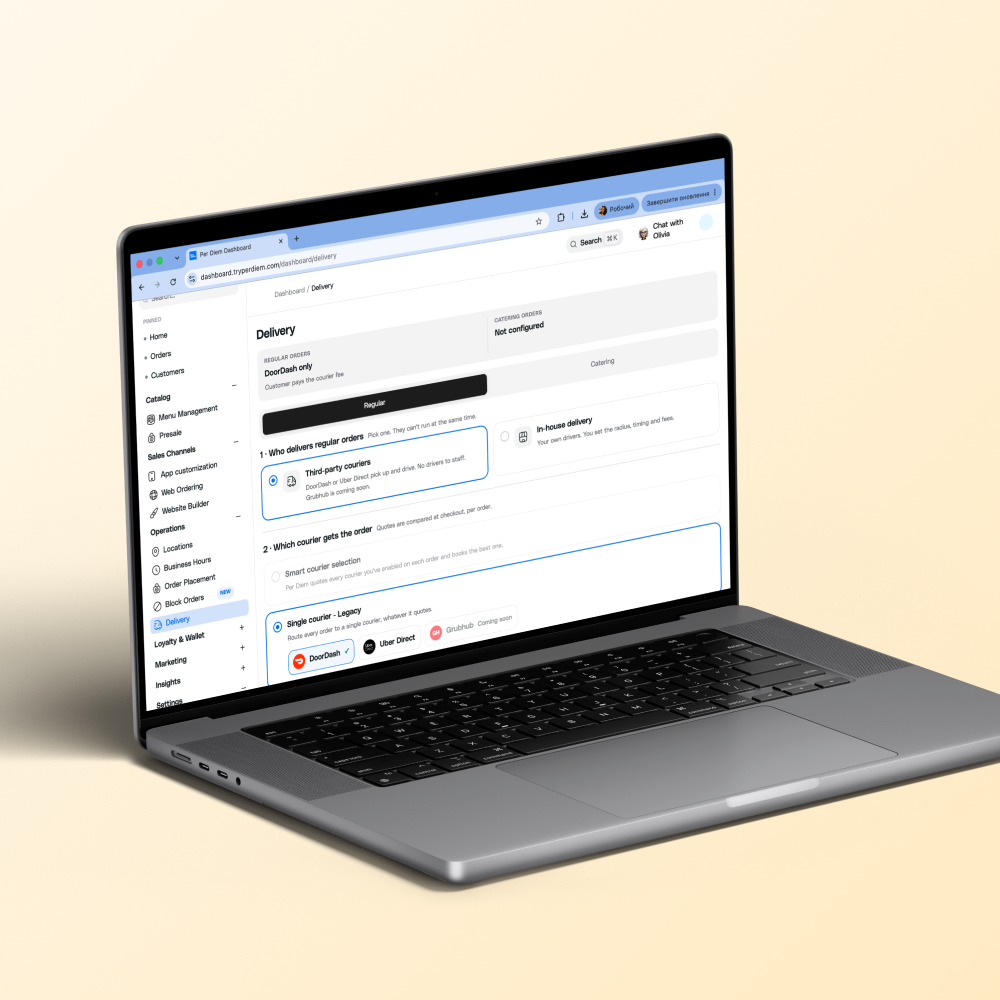
For restaurants using Per Diem, these decisions can be managed as part of the direct ordering experience. Restaurants can configure their delivery area, set delivery prep time, control how far ahead customers can schedule orders, and use supported delivery options such as DoorDash Drive, Uber Direct, or their own delivery operation.
The result is a delivery experience built around the restaurant's real operations, with fewer points where an order can go wrong after the customer has already checked out.