



















Artificial intelligence
How Starbucks Uses Deep Brew AI to Increase ROI and Store Performance
Feb 3, 2026
TLDR
In 2019, Starbucks introduced Deep Brew, an internal AI system to manage the growing complexity of its operations. Thousands of stores, millions of customers, and constantly changing buying habits made traditional decision-making harder to manage. Deep Brew was built to analyze customer activity and store data in real time, then turn those insights into automated actions. From personalized app offers to better inventory planning, the system helped Starbucks run more efficiently and increase its ROI by 30%, signaling a new way for coffee businesses to operate using data instead of guesswork.
Why Starbucks Built Deep Brew in the First Place
With over 38,000 stores, Starbucks faced a common expansion challenge. Each store had different traffic patterns, different customer habits, and different sales trends. Manual planning could not keep up with this scale.
Marketing teams could not design campaigns for every type of customer. Store managers could not predict demand accurately every day. Decisions about promotions, stock levels, and staffing often relied on experience instead of current behavior.
Starbucks needed a system that could read data from all stores continuously and turn it into practical actions. Deep Brew was built to solve this gap by turning everyday store and customer data into automated decisions.
What Deep Brew Does for Starbucks Stores and Customers
Deep Brew connects four everyday parts of a Starbucks store into one intelligent loop.
First, it helps with customer recognition. By learning from order history and visit patterns, the system understands who the regulars are and what they usually prefer. This allows the app to send targeted marketing offers and suggestions that feel timely and relevant instead of generic.
Second, it provides performance insights. Deep Brew studies sales trends, product movement, and store activity to highlight where improvements can be made. This helps identify which items deserve more attention and which time periods need support.
Third, it enables demand prediction. The system forecasts how much food and beverages a store will need based on past behavior and current patterns. This guides stocking decisions and reduces waste.
Finally, it drives decision automation. Routine planning around promotions, inventory, and staffing is handled through data patterns, which frees managers to focus more on service inside the store.
This is why Deep Brew works so well. Customer behavior, marketing actions, and store preparation are all guided by the same intelligence working quietly in the background.
What This Means for Independent Coffee Shops Today
You might not have hundreds of locations, but you do have customers.
And if you use an ordering system, it knows what sells the most, which hours are quiet, which days bring lower sales, and which customers return often. The information is there. The challenge is finding the time to study it and decide what to do with it.
This is where many coffee shops get stuck because the owners don’t have time, and marketing teams require a huge budget that many local shops can’t prioritize.
And if you run a discount because sales feel slow. You may send a promotion without knowing which customers will respond. You may plan campaigns based on observation instead of clear patterns.
Over time, this turns marketing into extra work that sits on top of running the store.
What Starbucks proved with Deep Brew is simple. When your store data connects to an automated system, these decisions do not need constant attention. The system reads patterns for you and turns them into timely actions in the background, while you focus on service, staff, and daily operations.
Bringing This Capability to Local Coffee Shops with Olivia
Per Diem powers mobile ordering and online ordering for coffee shops. Every order placed through the platform builds a clear picture of how your store performs. What sells well. What sits unnoticed. When customers visit. When sales drop. Which guests return often.
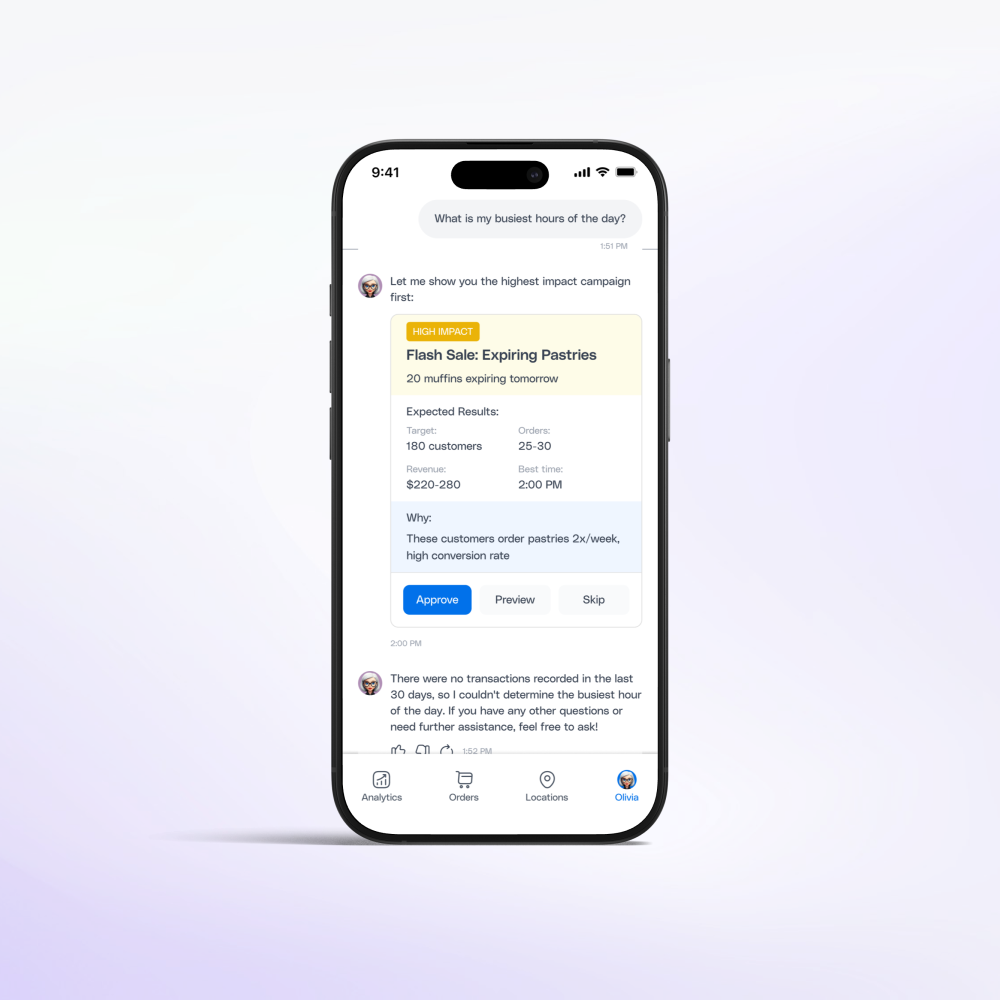
Olivia sits on top of this data inside your merchant dashboard and acts like your personal AI marketing assistant.
Instead of showing you reports and expecting you to figure out what to do next, Olivia studies your store patterns and turns them into actionable insights.
For example, Olivia can understand:
- Which day of the week consistently brings lower sales
- Which products are popular but rarely promoted
- Which items often sell together and can be bundled
- Which customers respond to offers and which ones stop visiting
From this, Olivia does the work that usually takes your staff hours of thinking and planning.
You can allow it to automatically prepare and run marketing campaigns, such as:
- Sending push notifications to the right customer groups at the right time
- Placing promotional banners inside your app based on current trends
- Creating coupons to support slow days or highlight specific products
- Scheduling these campaigns without you having to monitor timing
You do not have to design campaigns, study graphs, or guess what to promote. Olivia uses your own store data to decide this for you.
This is how independent coffee shops can use their everyday data in a way similar to how Starbucks uses Deep Brew, without needing technical knowledge or extra effort.
Can AI Make a Coffee Shop's Service Feel More Personal? Read the blog to learn more.
How AI Can Improve Your Daily Store Operations
The biggest benefit of AI for coffee shops is not only in marketing. It is in how smoothly the store runs each day without extra thinking from the owner.
When your ordering and customer data are read continuously, clear patterns begin to appear. You start to see which products often sell together, which hours need more staff attention, and which days require a push to increase sales. Instead of reacting after a slow day, you can act before it happens.
Ai can help you:
- Prepare for busy hours using past traffic trends
- Reduce waste by stocking based on real demand patterns
- Identify items that deserve better placement or promotion
- Understand store performance without spending time inside reports
This removes the constant cycle of checking numbers and guessing what to do next. The system turns data into simple actions while you focus on service, staff, and customer experience.
Why Many Coffee Shops Hesitate to Use AI
A common concern among smaller businesses is that AI feels complex or unnecessary. Many owners rely on experience and intuition built over years of running their stores. That knowledge is valuable, but as customer behavior shifts toward mobile ordering and digital engagement, manual methods become harder to manage.
The hesitation often comes from thinking AI will replace human touch. In reality, it does the opposite. It removes the burden of planning promotions, studying reports, and monitoring patterns so that owners and staff can spend more time with customers.
Tools like Olivia are built for this reason. They work using the data you already generate and turn it into marketing actions and performance insights without requiring technical effort from you.
The Future of Coffee Retail Belongs to Data-Guided Decisions
Starbucks and Dunkin’ showed that data can guide how a coffee business runs without changing the warmth of the in-store experience. Deep Brew works in the background while baristas and managers focus on people.
Independent coffee shops now have access to similar capabilities through modern ordering platforms. By allowing AI to handle promotions, timing, and performance analysis, you create more time to focus on quality, service, and community.
The advantage no longer comes from having more resources. It comes from using your existing data more intelligently.
Book a demo today and watch Olivia turn insights into ready campaigns.